What is education? Definition, aims, and objectives of education
Education is a behavioral change. It is a process in which learning facilitates or acquires knowledge, skills, values, beliefs, and habits

Education is a behavioral change. It is a process in which learning facilitates or acquires knowledge, skills, values, beliefs, and habits
Education
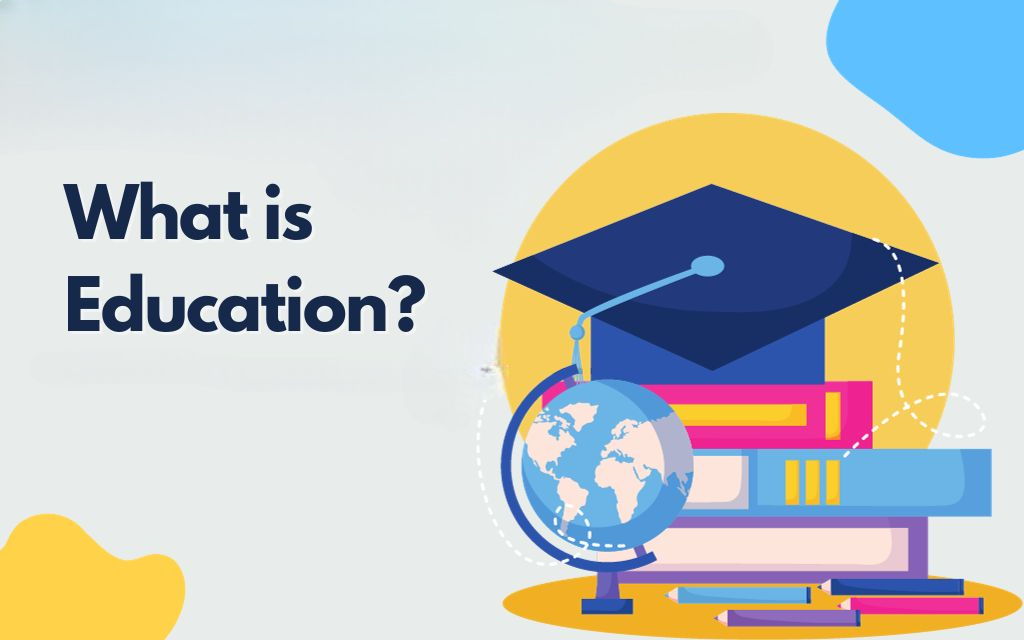
What is education?
Education is a behavioral change. It is a process in which learning facilitates or acquires knowledge, skills, values, beliefs, and habits. Some say education is a process of growth and development, while others say it is a social process, a preparation for life.
Origin of the word education:-
The Bengali word 'education' is derived from the Sanskrit that has, which means to rule. A synonym for education is 'vidya', derived from the Sanskrit dhatu vid, which means 'to know' or 'acquire knowledge'. The English word for education is derived from several Latin words. According to some, the word is derived from the Latin Educere, which in English means to lead out, i.e., to bring out all the mental powers that are innate in the mind of the child and student.
According to the second opinion - the root of the word education is derived from the Latin word Educare which means to bring up - that is to nurture or care. Education in this sense is the process of raising a child properly with certain goals and ideals in mind.
According to the third opinion - the English word Education comes from the Latin word Educatum, which means - The act of training. According to this view, education means training the child or student to master some skills useful in future life.
Joseph Twadell Shipley in his Dictionary of Word Origins writes that the word education comes from the Latin words Edex and Duccrduc. The literal meaning of which is respectively to take out, to show the way. And in a broader sense gathering information and developing latent talent.
Education according to modern Indian educationists:-
“That is what I call the best education, which does not merely impart information, but builds our lives in harmony with the universal being” – Rabindranath Tagore.
Education according to western educationists:-
To develop the body and mind of the students and thereby realize the sweetness and truth of life. — Aristotle.
Education is the spontaneous self-development of the child, which helps to make a normal human being free from all artificiality in human society. — Rousseau.
Learning is the process of living through continuous renewal of experience. — John Dewey.
Education is a supportive process for the overall development of body and mind according to the child's abilities. — Plato.
Education is the realization of latent potential. — Froebel.
Concept of education:-
If we analyze the meaning of education, we can see two meanings, one is education in a narrow sense, and the other is education in a broad sense.
Education in a narrow sense refers to imparting curriculum subjects to students by educated and elite persons in front of a specific curriculum through an institution. The characteristics of education in the narrow sense are –
1. To increase knowledge, to deglave.
2. It is a one-way process.
3. School-centric and Putin-dependent. 4. Immutable and stationary processes.
Education in a broad sense:-
According to educationists the significance of education in the broadest sense is to develop the inherent latent potential of the student.
The characteristics of education in the broad sense are –
1. It is a lifelong process
2. Education in a broad sense is a two-way process.
3. It is a lifelong developmental process. This education helps in developing the child's innate ability, inherent potential, and spontaneous thinking.
4. This education is done according to the needs and inclinations of the students.
5. This education helps in behavioral change, the development of values, formation of liberal attitudes.
Objectives of Education:-
According to Aristotle – “The true purpose of education is to attain happiness through the sanctioned sacred activities of religious discipline.”
According to Socrates – “The purpose of education is the destruction of falsehood and the discovery of truth.
According to Plato – everything necessary for the full development and improvement of body and soul is included for education.
The famous educationist Herbert said – The purpose of education is the full development of the child's potential and passions and the expression of moral character.
According to John Dewey – The purpose of education is self-realization.
According to Rousseau - the purpose of education is to develop good habits.
According to Froebel, the eminent educator who invented the Kinder Garden method – the purpose of education is the realization of a beautiful, trustworthy, and holy life.
Persian said that the purpose of education is to build character, prepare for a fulfilling life, and build a good body and a good mind.
Parker said - the purpose of education is to develop all the qualities that the student has come to this world with for the self-expression of a complete human being.
According to Comenius – the overall development of the child should be the aim of education. And the ultimate goal of man will be to get happiness in the presence of God.
Aims of Education:-
According to John Dewey – Aim is a foreseen end that gives direction to a certain activity or motivates human behavior. That is, a goal is a predetermined desired objective that governs our actions or motivates our behavior.
Every conscious effort has a specific purpose or goal. Since education is a conscious effort, it is natural that education also has goals.
Encyclopaedia of Modern Education says that education is objective moral work. Therefore aimless education cannot be thought of. (Education is a purposeful and ethical activity. Hence it is unthinkable without aims.)
One of the aims of education is to enable and accelerate the development of children to make them complete human beings so that they can better and meaningfully adapt and adapt to the environment around them.
In the words of Aristotle – “Every art does something good, Education is an art. It is to be seen what good is done by education to man and society.
Education is a changing continuous dynamic conscious social process. Therefore, the goal of education has been disrupted in different ways by different educationists in different countries over the ages according to different educational philosophies.
The goal of education in ancient India was self-knowledge or self-realization. But the goal of modern education is to make the child a useful citizen by developing him all around.
The aims of education as conceived by educationists and philosophers at various times are –
(a) education aims to impart knowledge:-
According to some educators, one of the goals of education is to help students gain knowledge or experience. As Socrates said – Knowledge is the power by which things are done.
(b) To inculcate moral sense :-
Education aims to awaken the moral consciousness of the child. Education will help in building moral character in children. Herbert said – A handful of good life is worth a bushel of learning. That is, a few honest lives are better than a lot of education.
(c) Inculcation of Christian consciousness:-
The aim of education is to acquaint society with past culture and cultural trends. In a word, developing respect for one's own cultural being.
(d) Building character:-
According to educationists, the goal of education is to build the character of the child. Gandhiji said that character formation is the only aim of education. Rabindranath Tagore said - The main goal of education is to make the character strong and efficient.
(e) Awakening of Spiritual Consciousness:-
Many philosophers and educators have emphasized the development of the spiritual life and the development of a better way of life –
"The aim of education is neither national efficiency nor world solidarity, but making the individual feel that he has within himself something deeper than intellect, call it spirit if you like."
That is, the purpose of education is not to increase national efficiency or to awaken the sense of world brotherhood, the aim of education will be to discover a consciousness in the heart of the individual that is inaccessible to the intellect which can be identified as spirituality.
(f) To build a beautiful city:-
Education aims to develop the child as a good citizen so that all the qualities of self-expression exist in him.
(g) Vocational Education or Manual Education:-
The aim of education should be such that it becomes helpful in earning a living. In one word that is called vocational education. Vocational education is a tool to bring comfort to life. According to John Dewey – a person is happy if he chooses his vocation and engages in work according to what he can do. Intellectually weak people can gain confidence through vocational education.
Besides, the remaining objectives of education are –
1. One of the aims of education is to convey the behavioral, political, and cultural values of society to the younger generation.
2. Developing respect for the natural environment.
3. Another important goal of education is to enable the child to make meaningful connections with different environments.
4. The basis of a democratic society is communism, a society without class discrimination, the development of a sense of cooperation and brotherhood.